local
SAS Institute
Customer story templates and a flagship report hub, designed and shipped on sas.com
swipe for role, timeline, tools, and impact
01Context
A summer internship that ended with the flagship report.
I joined SAS’s Marketing department as a Summer Design Engineer Intern. The role was extended into a year-round position spanning both design and the frontend code that ships live on sas.com.
This case study centers on the two projects that bookend that internship: the customer success story templates I inherited as my first real assignment, and the Trust Hub, the flagship report experience I ended up owning outright.
What happened in between is the story of how I earned that trust.
02Process
Earning trust one project at a time.
Customer story templates
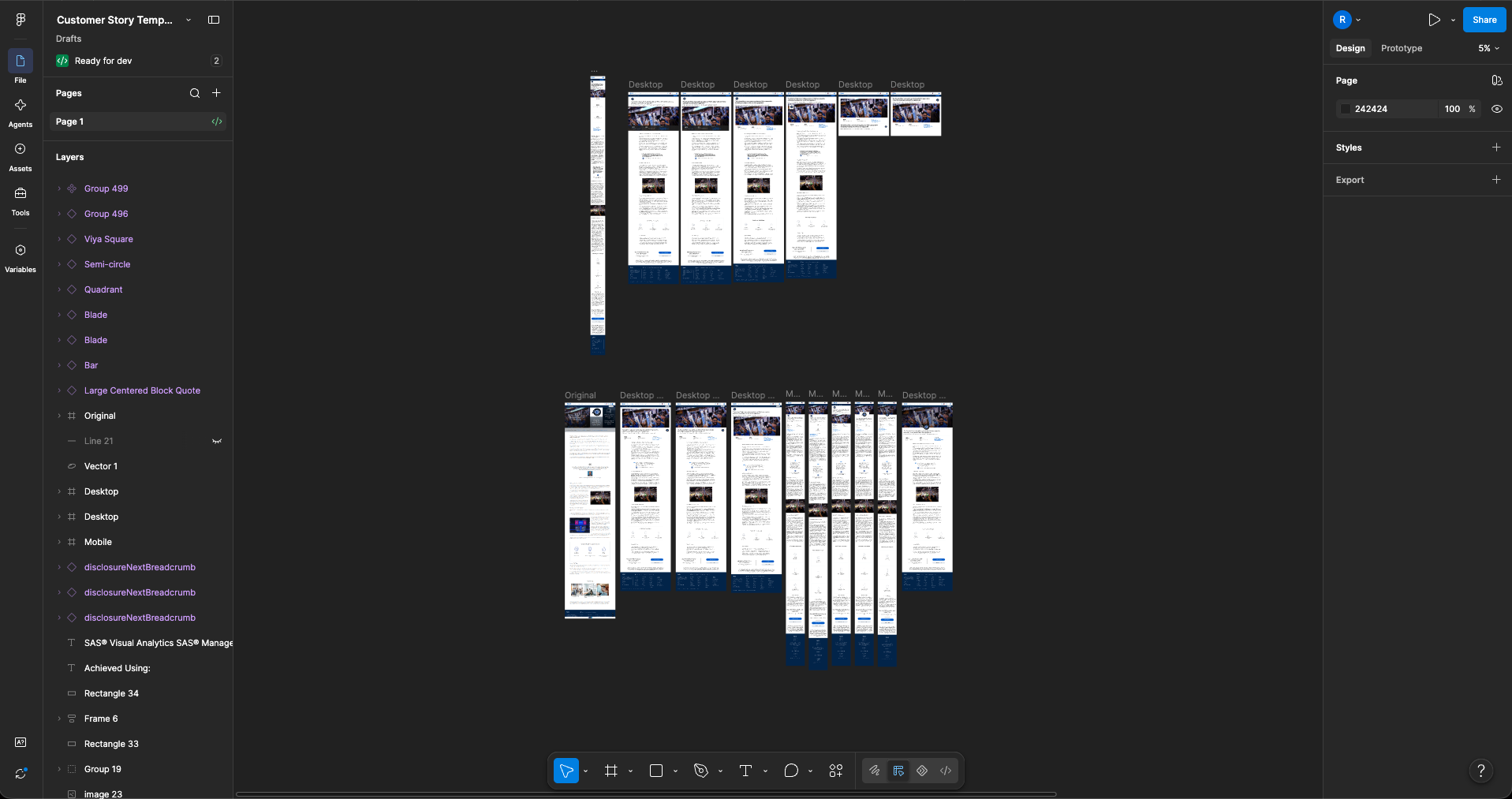
My first project was rebuilding SAS’s customer success story page templates in Figma as a production-ready prototype, balancing SAS’s brand requirements against AEM’s technical limitations and accessibility compliance.
It doubled as an unofficial test of brand fluency. After a few rounds of iteration, I could tell what felt like SAS and what didn’t without being told, and that’s when my manager started trusting me with more.
Header utility menu
I redesigned the site header’s utility menu, replacing the flag-based country/region selector with a language selector. I explored a globe-icon pill as the trigger, with both mobile and desktop treatments.
50th Anniversary exhibit
I designed three interactive pop-up modular window concepts for SAS’s 50th Anniversary exhibit: a vitals scrub, a percolation tap grid, and a B-tree roots auto-grow visualization.
Trust Hub
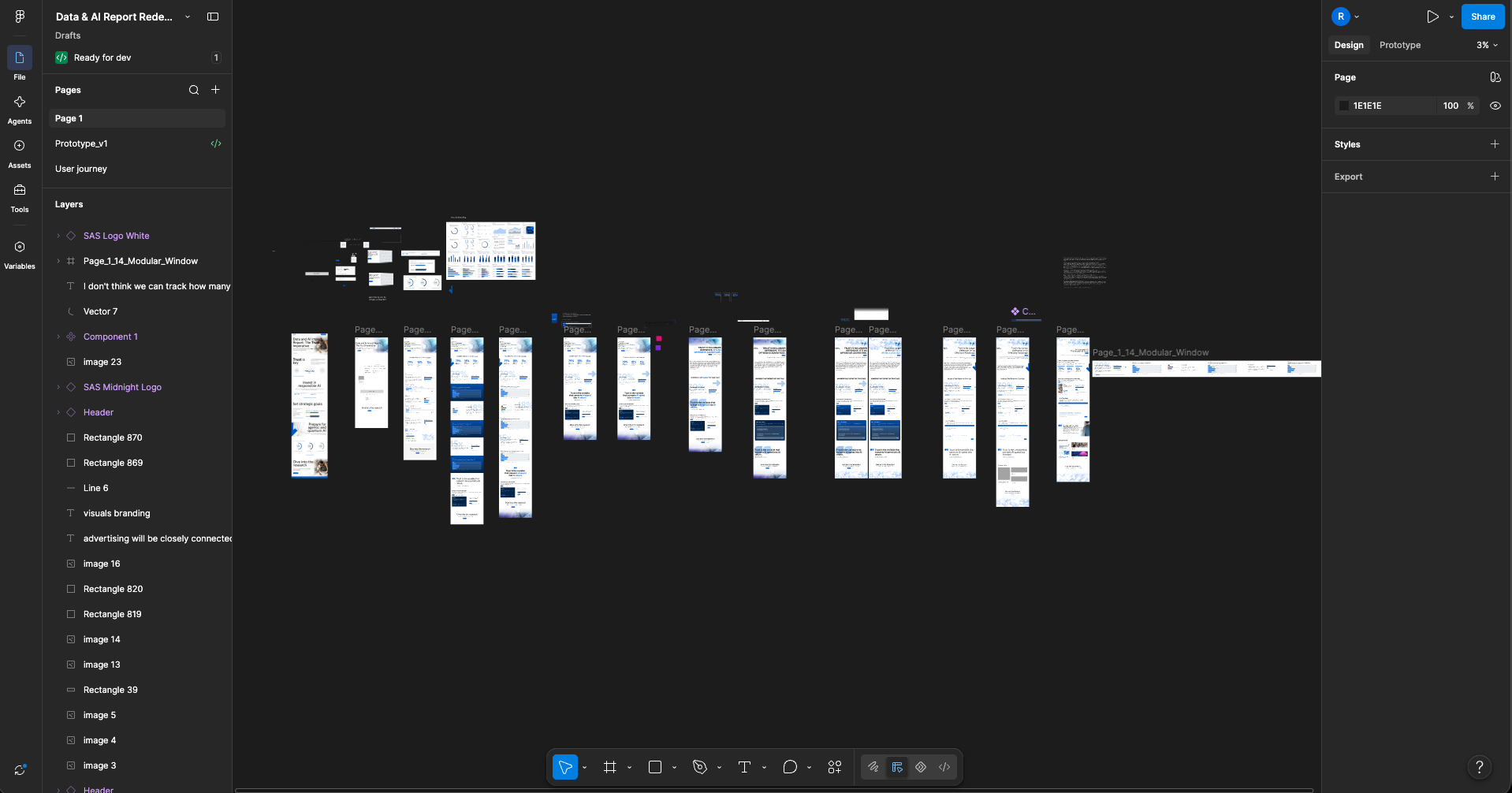
I owned SAS’s flagship Data & AI 2026 report hub end-to-end: full layout, component architecture, and interaction design from concept through engineering.
The first iteration was due in a week, which was too tight for any low-fidelity work or sketching. I went straight into high-fidelity design using only the previous year’s report page as a reference, and delivered a full design after one day. My manager told me afterward that he fully trusted my work and was genuinely impressed by how fast I’d picked up SAS’s design language.
Everything after that was refinement, landing on an editorial “Instrument & Ink” direction after extensive iterative prototyping. The final version lives on sas.com as “The Impact of Trust”.
03Impact
Shipped on sas.com, with 50k+ views.
The customer success templates and header redesign shipped live on sas.com under the real AEM and accessibility constraints, gathering 50k+ views.
The Trust Hub’s survey interactive ran on real questions from the actual report, alongside a shareable trust-profile card.
That growing trust is also what turned a summer internship into a year-round role: the fastest, clearest signal that the work was landing the way I meant it to.
04Reflection
Start further along the trust curve.
The real through-line across this internship wasn’t any single deliverable, but the trust I built, project by project. It started with a manager testing whether I understood SAS’s brand well enough to work inside it, and it ended with him handing me a flagship report and stepping back.
Going into my next role, I want to start further along that curve: less time earning the benefit of the doubt, and more time doing the ambiguous, high-stakes work outright.