local
SolHacks
Marketing Chair → Director of External Marketing → Executive Director
swipe for role, timeline, tools, and impact
01Background & Problem
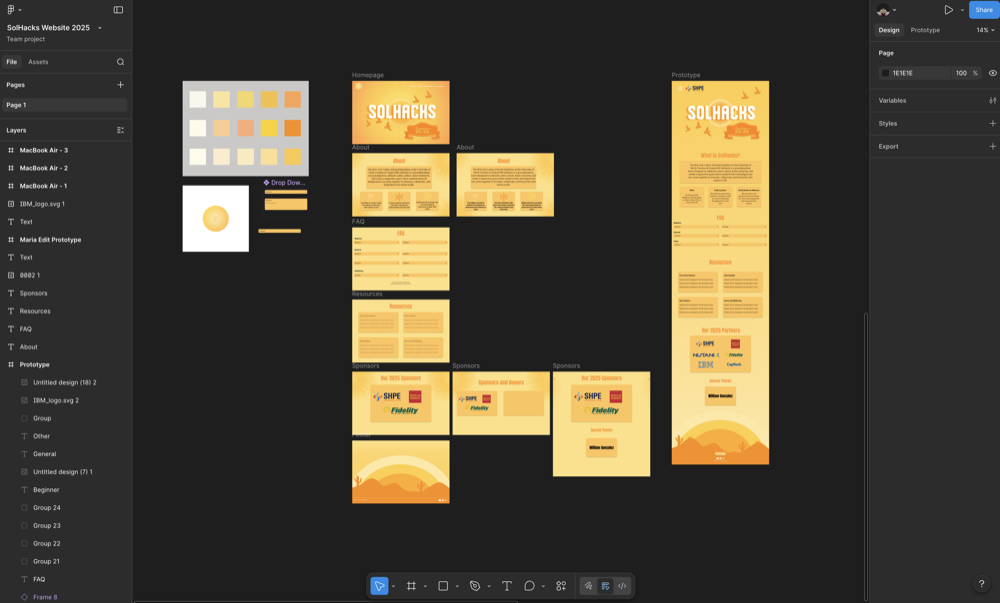
SolHacks launched in 2025 as UNC SHPE’s first hackathon. As Marketing Chair, I built the brand and website from scratch, but design ownership was split across the team, and the site shipped desktop only due to time constraints.
Moving into Director of External Marketing and then Executive Director, I took on full design ownership of the event, brand systems, and the site itself, with a mandate to grow attendance and partnerships while professionalizing how the organization worked.
02Process
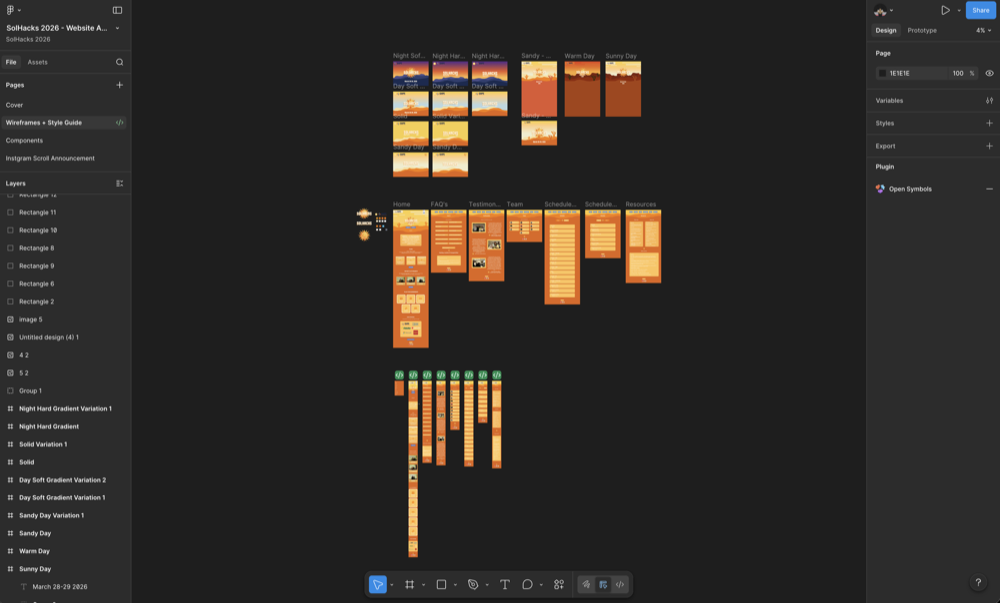
- 2025’s identity work meant matching the site’s palette to our existing club logo under a tight pre-event timeline, leaving no room for research or testing, just what was necessary to ship. For 2026, our Executive Director handed off a newly designated SolHacks logo and gave me real room to explore: night gradients, day gradients, solid fields, and a desert/sandy-day palette, a dozen-plus directions before landing on the final system.
- My own Figma fluency grew alongside the brand. 2025 was a flat, single-page prototype; by 2026 I was building with real components and variants, then wiring the whole thing into an interactive, prototyped flow instead of static screens.
- Restructured nine committee roles and built a master semester timeline so the org didn’t run on one person’s memory.
- Recruited a dedicated Director of UX role to carry the system forward after graduation.
- Expanded outreach, landing partnerships with Microsoft, IBM, Netapp, Wells Fargo, Fidelity, and more.
Direction
My first instinct for the 2026 hero was a cooler blue-and-orange complementary palette. Our Executive Director wanted to stay true to a warm-dominant identity instead, so I moved the exploration in that direction. The desert and sandy-day palettes are the result of that call, not my original one, and it’s the direction that actually shipped.
Iteration
The 2025 site had no mobile support. For 2026, I specifically added mobile-responsive views to close that gap, a direct response to what the first version got wrong.
Ownership
I was the only person on the team with real UX training, which meant a lot of my role was saying no with reasoning attached. I turned down a four-CTA hero and a request to fit all of the event’s information onto a single path, both in favor of clearer hierarchy and dedicated pages. These were decisions I had to defend to a non-designer leadership team.
03Results
Year one drew 66 attendees and 16 projects. With the 2026 rebuild, mobile support included, attendance was 150+, on a brand and system to outlast my own involvement.
04Reflection & Next Steps
Being the only person on the team who could speak to UX also meant learning to advocate for those decisions in terms a non-designer leadership team would accept. This was the first time I’d had to use this type of communication on this level of scale before, and it was one that matters as much on large projects as the design work itself.
Heading into 2027 as Executive Director, the real test isn’t the 2026 numbers, it’s whether the system holds without me in the room. The committee restructure and the dedicated Director of UX role were built specifically so continuity doesn’t depend on any one person, including me.